Frankenstein Sees the Monster Again for the First Time
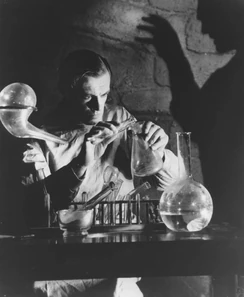
This is an image of Victor creating the monster lone in his laboratory. The image came from http://content.artofmanliness.com/uploads//2014/02/frank.jpg
The theme of isolation in Frankenstein raises many questions virtually the office of community and its importance. Many characters in the novel observe themselves in isolated positions, and a few endure grave consequences considering of it. Characters suffer from both physical and emotional isolation, although, as in the case of the monster, the isolation is not always cocky-inflicted. Victor Frankenstein, on the other mitt, chooses to isolate himself from his family, his peers, and even the monster he created. Throughout the novel, we see isolation manifested in multiple ways in multiple characters.
Mary Shelley makes this theme apparent in the very beginning of the novel past using setting and nature. The remote Arctic is her selection for introductory setting. It is not surprising that Shelly would choose to brand this a theme in her debut novel; isolation and abandonment were characteristic of many Romantic texts. Samuel Taylor Coleridge, an early on Romantic poet, also chose to use nature as a way to engage isolation in his poem, "The Rime of the Ancient Mariner" by showing the mariner unnecessarily killing an albatross. The mariner'south punishment for killing the albatross is watching his coiffure die in front of him. Coleridge depicts the mariner as an perpetual loner based on his choices, and shows that he is eternally cursed because of this (Van O'Connor).
In Frankenstein, horrible things happen when a character is isolated from the others. When Victor's knowledge and appetite are unchecked past his peers, a monster is created. When Elizabeth is left alone on her wedding dark, the monster attacks. When lodge abandons the monster, he becomes enraged and malicious. These instances evidence that the destructive power lies not in the monster or his creator, merely in confinement. Shelley uses this theme and its manifestation in her characters to pose questions about community, knowledge, and its role in society. Is unbridled noesis always unsafe, or is there a heart ground? Should one abandon his or her pursuits if they are driving him or her away from a community? Is information technology possible for someone to be more intellectually advanced than his or her peers and nonetheless maintain a sense of community with them? Mary Shelley challenges her audition to answer these questions and more about isolation.
Contents
- one Relevant Characters
- 1.ane Victor Frankenstein
- ane.2 The Monster
- 1.3 Helm Walton
- two Major Scenes
- 2.1 The Creation of the Monster
- 2.two The De Lacey's Rejection of the Monster
- 3 Impact in/for Frankenstein
- iv References and Suggestions for Further Reading
Relevant Characters
Victor Frankenstein
Victor Frankenstein embodies the theme of isolation meliorate than any other graphic symbol in the novel because he experiences information technology in ii means. Early on in the novel, Victor tells Captain Walton of his babyhood and of his thirst for the pursuit of knowledge, especially in the realm of science. While Victor is in higher at Ingolstadt, we run into him begin to detach from society. He spends all of his fourth dimension in the lab, where he creates the monster. When Victor sees the monster and realizes the extent of what he has washed, he becomes an agent of isolation by rejecting his own creation, setting into motility the madness of the monster. After that, every encounter that Victor has with the monster happens when he is lonely. When he goes for a walk in the Alps without his family unit, the monster appears and demands a mate. On his wedding night to Elizabeth, he checks outside for the monster earlier retiring to bed, and this is when the monster attacks his new wife. Victor embodies the theme of isolation, likewise every bit isolation'south consequences, by beingness both its victim and its musical instrument.
The Monster
The monster experiences isolation in Frankenstein as a victim. He is secluded from humanity because people alienate him based on his horrific looks, which ultimately causes him to turn to violence. He experiences rejection start at the hands of his own creator, and so by the townspeople at a modest hamlet. The people run from him screaming in terror, because although his search for nutrient is innocent, his inhuman looks crusade the villagers to believe differently. Finally, the monster is scorned past the De Lacey family, who he has been observing for a number of months and has grown to love. The De Lacey family unit's pick to isolate the monster is what truly pushes him to enact violence on his creator, Victor, who made him so hideous. Shelley dares her readers to contrast this type of isolation with the type that Victor undergoes. Is social rejection even more poisonous than the choice to exist segregated from that guild?
Helm Walton
Captain Walton, the novel's frame narrator, is another instance of self-inflicted isolation, but also of community. He is sailing the Arctic Ocean in hopes of exploring the North Pole when he comes across Victor and learns his story. Nosotros read his letters to abode where he describes not feeling connected with any of his coiffure members. Shelley displays isolation through Walton initially by just placing him in the Chill, a very secluded and void place. The novel ends with Victor finishing upwards his narrative to Walton, and we find out that Walton abandoned his pursuit of the North Pole. Why? Nosotros discover through his letters that his coiffure threatened mutiny if he continued sailing to the North Pole, so he turned dorsum. Shelley uses Walton as both a parallel to Victor and a contrast to him. Like Victor, he desired recognition and was willing to have risks in club to fulfill that desire. Withal, unlike Victor, Walton was surrounded by a people who advised him of his poor judgment and helped him make the choice to return to prophylactic waters. What would have happened if Victor had been surrounded by this type of community, instead of isolating himself from information technology?
Major Scenes
The Creation of the Monster
The first time that nosotros truly see the theme of isolation manifested in Victor is when he is a student in college. At Ingolstadt, Victor studies natural science and anatomy and becomes enthralled with the thought of cosmos; his ambition to be called a creator is overwhelming. He says "A new species would bless me as its creator and source;…No male parent could claim the gratitude of his child so completely as I should deserve theirs" (Shelley, 34). This wish is what prompts his disengagement from society as he begins to put together his animate being. He stops writing dwelling and distances himself from his colleagues, focusing all of his attending and free energy on creating his new species. Nosotros see the concrete effects of his isolation before the animal is fifty-fifty brought to life. Victor becomes increasingly pale and depressed, growing sicker and sicker as he comes closer to producing life. He says of himself, "My cheek had gone stake with report, and my person had become emaciated with confinement" (Shelley, 35). After the monster is created, Victor immediately rejects him and urgently leaves the apartment. The monster is brought into the world with disdain; Victor automatically assumes that his creation is inherently evil and spends the dark pacing and worrying about his family, specially his intended wife, Elizabeth, which foreshadows her fate later in the novel. In this scene sequence, we see where Victor'southward isolation begins, how information technology affects him, and finally, how he inflicts information technology upon another living thing. Victor exiling his creature serves as a channel for the intense irony in the novel: Victor isolates himself in society to create this being of which he is terrified. He rejects information technology, which causes it to impale the people he loves most, leaving Victor more than lonely than always earlier. Although Victor ultimately brings all of his isolation upon himself, he embodies the theme and its consequences improve than any other character.
The De Lacey'south Rejection of the Monster
In sharp contrast with Victor, the monster's experience with isolation is entirely out of his control. As readers, we don't know the monster's story until the second book when he confronts Victor in the Alps to demand a female companion. The monster tells of his experiences with desolation, which ultimately works to evoke sympathy from the readers on his behalf. His account ends with his most traumatic rejection, which came at the easily of his beloved De Lacey family. The creature had been watching the De Lacey family from a hovel virtually their house, and had learned everything from them: linguistic communication, literacy, and social practices. He felt very connected to the family and repeatedly calls them endearing names such as his "friends" ano his "honey cottagers." One mean solar day, the family leaves on some errands, leaving the blind patriarch of the family at home. The animate being approaches him, hoping to tell his story to Mr. De Lacey and gain his skillful graces before the residue of the family unit sees him, because the brute's unnatural looks accept been his social downfall. He knows the importance of this moment, and says, "This was the 60 minutes and moment of trial, which would determine my hopes, or realize my fears" (Shelley, 101). The rest of the family unit comes home while he is speaking to Mr. De Lacey and the monster tells Victor, "Who can describe their horror and consternation on beholding me?" (Shelley, 103). They physically forcefulness the monster out of the cottage. It is this rejection and the isolation that follows that is the turning point for the creature. Until this point, he never enacted any violence on some other living thing, but subsequently, he wishes to revenge himself confronting all humans, especially his creator. This is his motivation behind killing Victor's brother, William. It could be argued that until the denial by the De Laceys, the being could be chosen a creature. Afterwards it, however, we tin can legitimately call him a monster. The isolation that the monster feels in this scene is his moment of transformation into what Victor assumed he was from the outset. This moment is the birth of the real monster. Shelley uses the De Laceys as an agent of the monster's transformation, and shows that their pick to deny the monster social credence is what makes him truly evil. As Shelley progresses her novel, it becomes clearer and clearer that the monster's solidarity is ultimately what causes him to be malevolent.
Impact in/for Frankenstein
Isolation serves an important function in Shelley's novel. A thorough understanding of this theme is important to the text considering it develops characters, exposes the consequences of itself, and generates challenging questions nearly the role of isolation and community in our everyday lives. Isolation touches the lives of every grapheme in Frankenstein in some mode. The about obvious are Victor and the monster, but through them, isolation seeps into everyone else'due south lives in the form of decease and destruction. Shelley makes it clear that there are two dissimilar types of isolation: cocky-inflicted and societal. We see self-inflicted isolation manifested in Victor; he detaches from his world and the people he loves and as a result, everyone suffers tremendously. Rejection from lodge is demonstrated in the monster's life. Over again and over again, he is turned away from honey and companionship, which what he has longed for since he was first brought to life. Eventually, he resorts to sinister deportment to avenge his miserable life. The persistent power of alienation as well shows the power of a strong community. Is community the just deterrent to unchecked knowledge? Would Victor have proceeded with his scientific conquests if he had had a customs of peers to audit his ambition? The entire novel is based on Victor's laboratory circumstances, but why do these circumstances occur? While Victor's ambition and pride are definitely what cause the cosmos of the monster, his isolation is the channel through which they come to fruition. Similarly, the monster's exclusion from society is the catalyst for his horrific deportment.
Adaptations of Frankenstein oft alter the presence of isolation and customs in the story. Many adaptations, such equally Young Frankenstein, show Victor in his laboratory with a lab assistant. Even the very first adaptation in 1823, a play called Presumption: or the Fate of Frankenstein, portrays Victor every bit having a retainer who aids him in the lab. This new graphic symbol changes Victor's office, and his responsibility to the monster substantially. Having some other "creator" in the lab with Victor causes the theme of isolation to go well-nigh obsolete. If Victor did not deed alone in creating the monster, and so the carnage that follows tin be blamed on the monster. Placing another person in the lab completely justifies Victor's insatiable ambition. A lab assistant totally eradicates the contrast betwixt the isolation of monster and that of Victor. Instead, we see only the solidarity of the monster. When this contrast between self-inflicted and societal rejection is eliminated, the audience loses any run a risk of sympathy for the monster. This is when we, as an audience, start to adopt Victor'due south conventionalities that the monster was born evil, when in authenticity, the evil lies in seclusion.
References and Suggestions for Further Reading
Peake, Richard Brinsley. "Presumption; or, the Fate of Frankenstein." Romantic Circles. Ed. Stephen C. Behrendt. University of Maryland, Aug. 2001. Web. xiii Feb. 2015.
Shelley, Mary W. Frankenstein: A Longman Cultural Edition, Second Edition. Ed. Susan J. Wolfson. New York: Pearson Education, Inc., 2007. 5-179. Print.
Sherwin, Paul. "Frankenstein: Creation as Catastrophe." Modern Language Association 96.5 (1981): 883-903. Print.
Van O'Connor, William. "The Isolation of the Poet." Poesy lxx.1 (1947): 28-36. JSTOR.
Source: https://mary-shelley.fandom.com/wiki/Isolation_and_Community
0 Response to "Frankenstein Sees the Monster Again for the First Time"
Post a Comment